Introduction
In a powerful and reflective address that resonates deeply with young members of the Bar, Chief Justice of India Justice Surya Kant underscored that law degrees from National Law Universities (NLUs) or other premier institutions are not a shortcut to practice in the Supreme Court of India. Emphasising the foundational role of the district judiciary, the CJI urged aspiring lawyers to begin their professional journey in district courts before transitioning to High Courts or the Supreme Court.
The remarks were delivered on January 19, 2026, during a felicitation ceremony organised by the Bar Council of Delhi (BCD) to honour Justice Surya Kant on his appointment as the Chief Justice of India.
Felicitation Ceremony at Delhi High Court
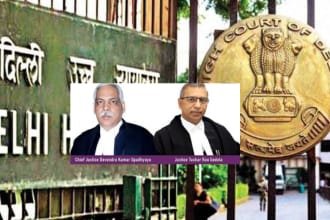
The felicitation function was held at the lawns of the Delhi High Court and witnessed participation from all bar associations of Delhi district courts, reflecting the collective respect and admiration for the CJI.
The event was attended by:
- Judges of the Supreme Court of India
- Judges of the Delhi High Court
- Senior members of the Bar, including:
- Senior Advocate Manan Kumar Mishra, Chairman, Bar Council of India
- ASG Chetan Sharma, Chairman, BCD Special Committee
- Senior Advocates Maninder Singh, Vikas Singh, and N. Hariharan
“NLU Degrees Do Not Guarantee Courtroom Excellence”
Addressing a widespread perception among law graduates, Justice Surya Kant highlighted a misconception prevalent among young lawyers, particularly those graduating from NLUs and reputed law universities.
He observed that many young advocates believe they must:
- Start directly in High Courts or the Supreme Court
- Avoid district courts, considering them less prestigious
Rejecting this notion, the CJI categorically stated that academic pedigree cannot substitute for grassroots courtroom experience.
“There is a misconception amongst young lawyers that they must practice in the High Court or Supreme Court as they possess a law degree from an NLU or equally important law university.”
District Courts as the Foundation of Legal Practice
Justice Surya Kant strongly advocated for district courts as the breeding ground of professional culture. According to him, these courts provide:
- Exposure to real clients
- Understanding of ground-level disputes
- Development of essential advocacy skills
He remarked:
“District courts are breeding centres of cultivating professional culture which give strength to the roots of the legal profession.”
The CJI emphasised that young lawyers must spend a formative period in district courts before aspiring for practice in higher judicial forums.
Personal Journey: Learning the Law at the Grassroots
Reflecting on his own journey, Justice Surya Kant shared insights from his early years in the legal profession. As a first-generation lawyer, he began his practice under the guidance of a leading senior civil lawyer, where he learned:
- Drafting of plaints, petitions, and affidavits
- Preparation for cross-examination and examination-in-chief
- Courtroom etiquette and professional discipline
He credited his district court experience as the cornerstone of his success.
“The success I gained in my life is because of my experience in the district role.”
Drafting Skills and Professional Credibility
Justice Kant recalled that after just one year of juniorship, he decided to begin independent practice. However, many senior lawyers continued to seek his assistance for drafting petitions due to the strong drafting skills he had developed in district courts.
This, he noted, demonstrated how grassroots training builds professional credibility, even at later stages of legal practice.
District Courts: Where Justice First Comes Alive
The CJI described district courts as the true centres of justice delivery, where litigants have their first interaction with the legal system.
He stated that:
- District courts handle the most immediate and human aspects of law
- They play a role equal to—or even greater than—appellate courts
“True justice resides only at the grassroot level courts, as first encounter of a client is when they go for enforcement of their right in the district courts.”
Healthcare Analogy: Primary Justice System
Using a powerful analogy, Justice Surya Kant compared district courts to primary healthcare centres.
“If a litigant is satisfactorily dealt with in this primary health centre, I am sure he will not be required to be shifted to higher hospitals. Definitely, he is not required to go to a trauma centre.”
This analogy highlighted the importance of effective dispute resolution at the first judicial level, reducing unnecessary litigation in higher courts.
Concern Over Declining Cross-Examination Skills
Justice Kant also expressed concern over the declining art of cross-examination, particularly in district courts due to increasing reliance on technology and procedural shortcuts.
He appealed to senior lawyers to:
- Actively mentor juniors
- Pass on traditional courtroom skills
- Preserve the art of oral advocacy
According to the CJI, cross-examination remains one of the most critical skills for any trial lawyer, and its erosion could weaken the justice delivery system.
Justice Surya Kant: A Story of Persistence
In his address, Chief Justice Upadhyaya highlighted Justice Surya Kant’s journey as an example of persistence over privilege.
Key milestones included:
- Being a first-generation lawyer
- Lacking any generational legal backing
- Becoming the youngest Advocate General of Haryana
- Rising to the office of Chief Justice of India
Justice Upadhyaya described his journey in one word: persistence.
“Persistence always beats privileges.”
Message for Young Lawyers and Law Students
Justice Surya Kant’s speech serves as a strong message to law students and young advocates, particularly those pursuing education from elite institutions:
- Courtroom skills matter more than college tags
- District courts offer irreplaceable learning
- Long-term success is built through patience and practice
His remarks reaffirm that legal excellence is shaped by experience, not shortcuts.
Conclusion
The Chief Justice of India’s address at the Bar Council of Delhi felicitation function is a timely reminder that the soul of the legal profession lies in district courts. By cautioning against over-reliance on academic credentials and encouraging grassroots practice, Justice Surya Kant has reinforced a core truth of advocacy—law is learned in courtrooms, not classrooms alone.
For young lawyers aspiring to practice before constitutional courts, the message is clear: strong roots in district courts create stronger branches in higher judiciary.
Also Read
5th NUJS International Client Counselling Competition 2026 at NUJS Kolkata, Register by 25 Jan!