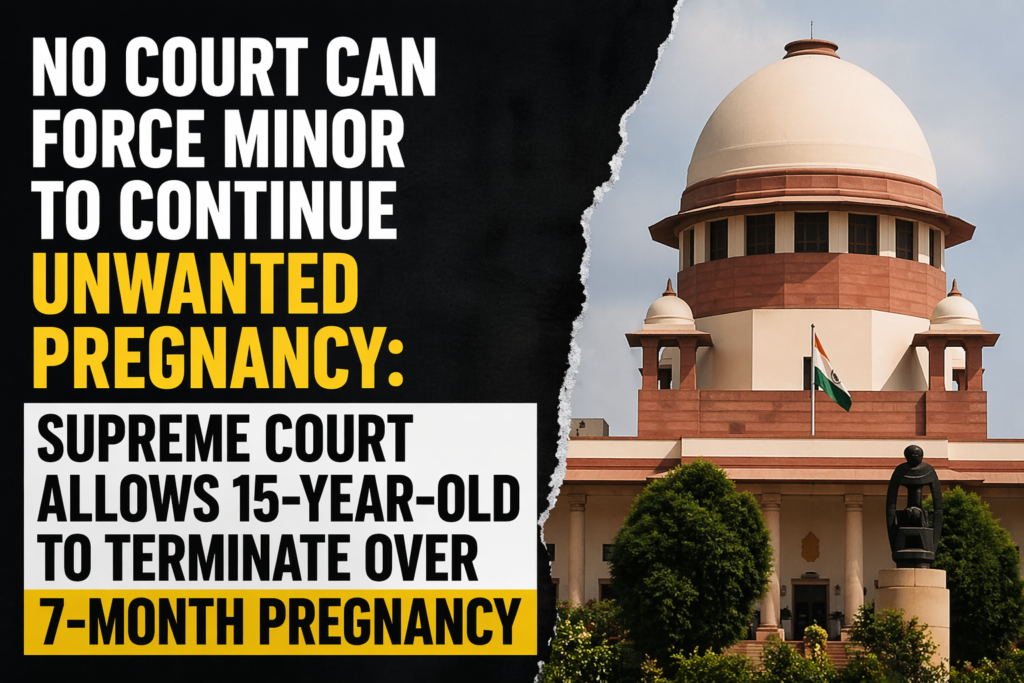
The Supreme Court has permitted a 15-year-old minor to medically terminate her pregnancy beyond seven months, holding that no court can compel a woman, particularly a minor, to carry an unwanted pregnancy against her express will. The Court emphasised that reproductive autonomy forms an integral part of personal liberty and privacy under Article 21 of the Constitution and must be given the highest constitutional protection.
The order was passed by a Bench comprising Justice B. V. Nagarathna and Justice Ujjal Bhuyan, which observed that forcing continuation of pregnancy in such circumstances would have serious consequences on the minor’s mental health, education, social standing, and overall development.
Court Emphasises Reproductive Autonomy as Fundamental Right
While allowing the termination, the Supreme Court reiterated that the right to make decisions concerning one’s body, particularly in matters of reproduction, is a core component of personal liberty protected under Article 21 of the Constitution.
The Bench observed that imposing unreasonable restrictions on this right, especially in cases involving minors and unwanted pregnancies, would render constitutional protections ineffective.
It held that:
No court ought to compel any woman and more so a minor child to carry a pregnancy to full term against her express will.
The Court clarified that such compulsion would disregard decisional autonomy and could result in grave mental, emotional, and physical trauma.
Join Legally Present’s WhatsApp Community for latest news updates
Welfare of Pregnant Minor Must Take Priority
The Court emphasised that constitutional courts must evaluate cases involving termination of pregnancy from the perspective of the pregnant individual rather than prioritising the interests of the unborn child.
Rejecting arguments that the minor could deliver the child and place it for adoption, the Bench held that such reasoning cannot justify forcing continuation of an unwanted pregnancy.
It observed that directing a minor to carry a pregnancy to term against her wishes would subordinate her welfare to that of the unborn child, which is impermissible under constitutional principles governing reproductive choice.
Continuation of Pregnancy Could Cause Irreversible Harm
The Court noted that continuation of pregnancy in the present case could lead to irreversible consequences for the minor, particularly considering her young age and the psychological impact already suffered.
Importantly, the Bench recorded that the minor had attempted to end her life on two occasions, highlighting the seriousness of the situation and the urgent need for judicial intervention.
The Court held that denying permission for termination in such circumstances would be contrary to settled constitutional principles recognising reproductive choice as a fundamental right.
Adoption Cannot Be a Ground to Deny Termination
Addressing the argument that the child could be given up for adoption after birth, the Supreme Court rejected the suggestion that adoption can be treated as a substitute for reproductive choice.
The Bench observed:
It is easy to say that if the pregnant woman is not interested in raising the child she may give away the child in adoption and therefore she must give birth to the child. That cannot be a consideration particularly in cases where the child to be born is unwanted.
The Court clarified that forcing continuation of pregnancy on this basis would negate the welfare and autonomy of the pregnant individual.
Courts Must Consider Risks of Unsafe Abortions
The Supreme Court also warned that denying permission for termination in cases involving unwanted pregnancies may push individuals toward unsafe and illegal abortion procedures.
The Bench observed that such outcomes would expose pregnant persons, particularly minors, to serious medical risks and undermine the protective role of constitutional courts.
It stated that judicial decisions must account for the real consequences faced by individuals seeking termination rather than imposing rigid restrictions inconsistent with constitutional guarantees.
Constitutional Courts Must Assess Circumstances From Minor’s Perspective
The Bench emphasised that constitutional courts must examine termination requests through the lens of the person seeking medical termination rather than from the perspective of the unborn child.
It observed that when a pregnant individual is willing to undertake the medical risks associated with termination, courts must carefully weigh the surrounding circumstances before directing continuation of pregnancy.
In the present case, the Court concluded that continuation of pregnancy was not in the interest of the minor and allowed the medical termination to proceed.
Significance of the Judgment
The ruling reinforces the principle that reproductive autonomy remains central to constitutional protection of dignity, privacy, and bodily integrity, particularly in cases involving minors and unwanted pregnancies beyond the statutory gestational limit.
It also clarifies that courts cannot rely on adoption as a justification for denying termination and must prioritise the welfare, mental health, and decisional autonomy of the pregnant individual.
The decision is expected to have continuing significance in cases involving late-stage termination requests where courts are required to balance statutory limits with constitutional protections.
Join Legally Present’s WhatsApp Community for latest news updates