The Punjab and Haryana High Court has upheld a Gurugram Family Court order allowing a minor child to remain in the custody of the father, observing that the mother’s residence in a paying guest accommodation and absence of a demonstrated caregiving support structure weighed against transferring primary custody. At the same time, the Court expanded the mother’s visitation rights and directed a shared parenting framework to safeguard the child’s welfare.
The judgment was delivered by a Division Bench of Justice Gurvinder Singh Gill and Justice Ramesh Kumari while deciding an appeal filed by the mother challenging the Family Court’s order dated May 30, 2024.
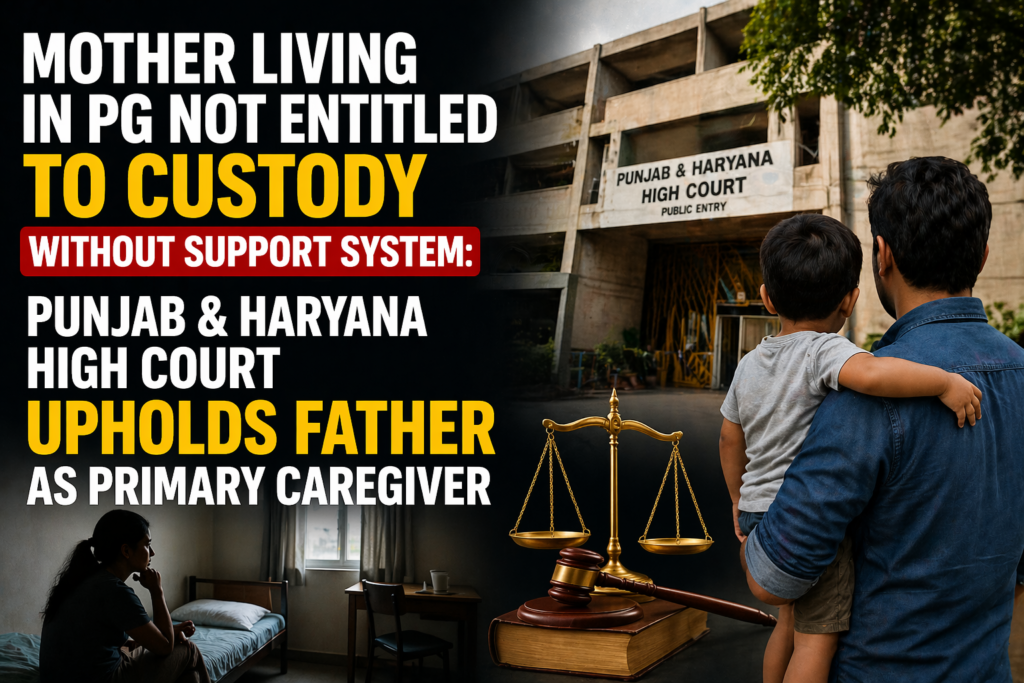
High Court Upholds Father as Primary Caregiver
The High Court affirmed the Family Court’s conclusion that the father was better positioned to provide a stable caregiving environment for the child. The Court noted that the father resided with his extended family in a four-room house and had access to additional support from relatives as well as domestic assistance.
In contrast, the mother was living in a paying guest accommodation and had not produced evidence demonstrating the availability of family members or caregivers who could assist in looking after the child during her working hours.
The Court observed:
The father is residing with his family. He has better accommodation consisting of four rooms than wife, who is staying as paying guest. She has not examined her mother to prove that her mother shall be available for the child to take care of him in her absence.
On this basis, the Court concluded that the Family Court had rightly declined to hand over custody of the child to the mother.
Welfare of the Child Remains Paramount Consideration
Reiterating settled principles governing custody disputes, the Court emphasised that the determinative factor in such cases is the welfare and best interests of the child rather than competing parental claims.
The Bench observed:
The issue of custody of the child is to be decided keeping in view the consideration of the best interest of the child and welfare of the child and not the conflicting or better rights of the parent.
The Court found that the caregiving environment available in the father’s household offered greater continuity and stability for the minor child.
Matrimonial Dispute Led to Custody Proceedings
The dispute arose following matrimonial discord between the parties after their marriage in November 2021. The mother alleged that she had been subjected to physical and mental cruelty and was forced to leave the matrimonial home in September 2023 while caring for the infant.
She further claimed that she was subsequently denied access to the child, prompting her to approach the police and initiate legal proceedings seeking recovery of custody.
The father denied these allegations and contended that the mother had voluntarily left the matrimonial home and was not in a position to assume primary custody of the child.
These competing claims formed the basis of proceedings before the Family Court and later the High Court.
Court Notes Absence of Reliable Caregiving Arrangement With Mother
The High Court agreed with the Family Court’s finding that the mother, being a working professional, had not demonstrated a dependable caregiving arrangement for the child during her working hours.
The Bench specifically noted that no evidence had been produced to show that her mother or any other family member would be available to assist with childcare responsibilities.
On the other hand, the father’s joint family setup, supported by a nanny and domestic help, was considered to provide a stable and continuous caregiving structure.
Visitation Rights Expanded Under Shared Parenting Arrangement
While declining to modify the custody arrangement, the High Court expanded the mother’s visitation rights to ensure meaningful involvement in the child’s upbringing.
The Court permitted the mother to keep the child overnight three times each month, generally across three weekends, with flexibility for adjustments by mutual consent between the parties.
In addition, the Court directed both parents to jointly take decisions regarding the child’s education, extracurricular activities and overall upbringing.
Directions Issued to Ensure Cooperative Parenting
The High Court also issued several directions intended to promote cooperative parenting and safeguard the emotional well-being of the child.
It ordered that:
- school holidays and festivals be shared between both parents
- the child’s birthday be celebrated jointly
- neither parent take the child outside India without the consent of the other
The Court further cautioned both parties against exposing the child to parental conflict or speaking negatively about each other in the child’s presence.
Court Emphasises Need to Protect Child’s Emotional Development
Highlighting the importance of maintaining a harmonious environment for the minor child, the Court observed that continued involvement of both parents plays a crucial role in ensuring emotional and psychological stability.
It advised both parties to prioritise the child’s welfare over personal differences and cooperate in implementing the shared parenting arrangement directed by the Court.
Senior Advocate Salli Bali along with advocates Jaiveer Bali, Archana Chauhan and Aarti Singh appeared for the mother. Senior Advocate Sunil Chadha along with advocates Kunal Muthreja and Tara Dutt appeared for the father.
Join Legally Present’s WhatsApp Community for latest news updates